Unlocking the Potential of Photoexcited Molecular Electron Spins for Room Temperature Quantum Information Processing
Published in Materials for Quantum Technology, Volume 4, Issue 4, 2024
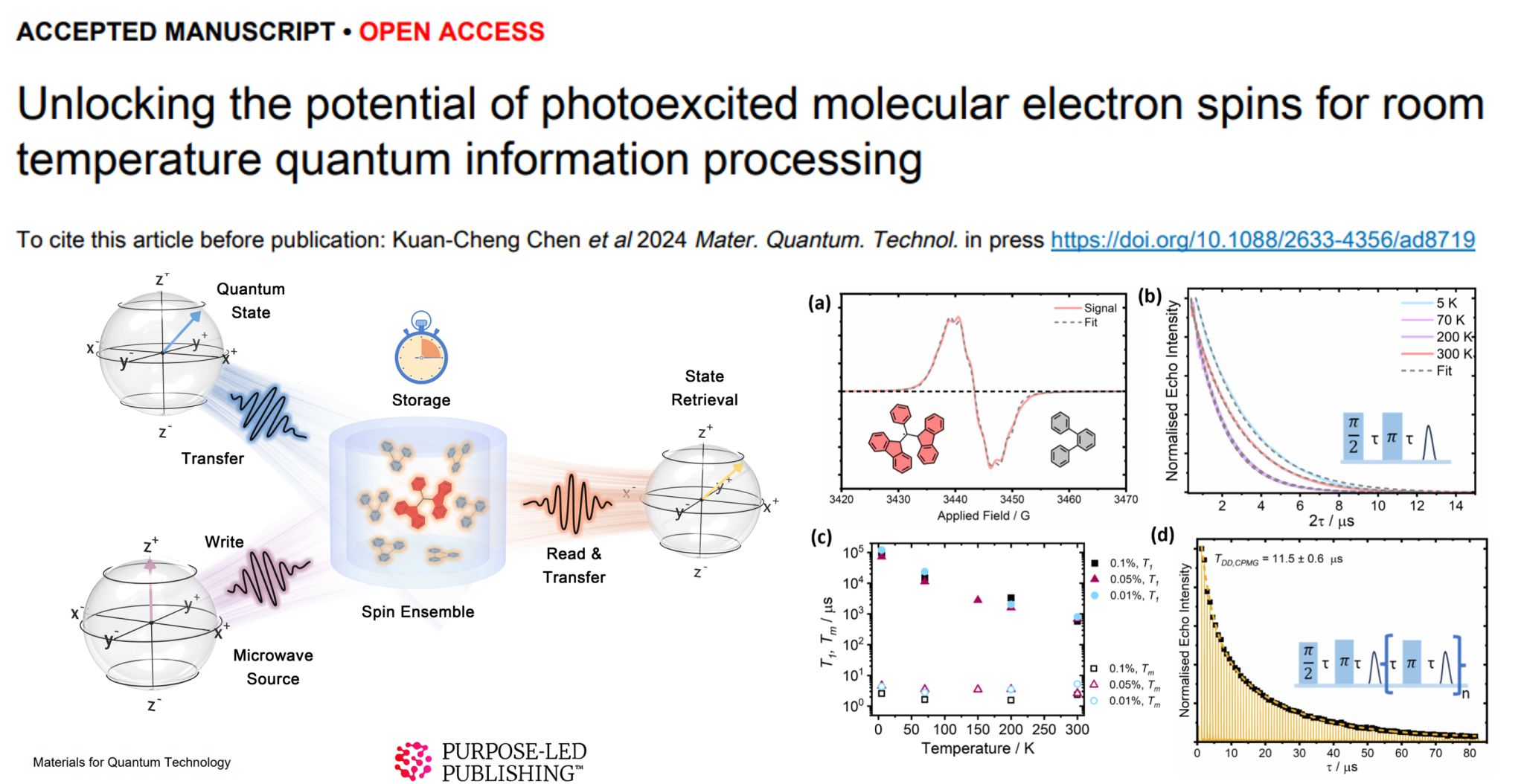
Future quantum memory and quantum networking technologies require reliable interfaces between light and matter that operate at room temperature with long coherence times. This study investigates an organic radical system designed to meet those requirements, using α,γ-bisdiphenylene-β-phenylallyl (BDPA) doped in an o-terphenyl host.
We demonstrate millisecond-scale spin-lattice relaxation and microsecond-scale phase memory times at ambient conditions. Additionally, this system is capable of producing an oscillating spin-polarized state via a co-dissolved photo-activated tetraphenylporphyrin moiety, enabled through a viscous liquid matrix that stabilizes the spin dynamics.
The work advances the field by combining high-performance molecular media, photoexcited triplet-radical spin polarization, and dynamical decoupling strategies. These insights pave the way toward scalable, room-temperature quantum spin systems that could be integrated into next-generation quantum devices.
Recommended citation: Kuan-Cheng Chen, Alberto Collauto, Ciarán J. Rogers, Shang Yu, Mark Oxborrow, Max Attwood (2024). "Unlocking the Potential of Photoexcited Molecular Electron Spins for Room Temperature Quantum Information Processing." Materials for Quantum Technology, 4(4), 045901.
Download Paper